The Moss Isn’t the Biggest Threat to Your Roof. The Cleaning Is.
What shingle manufacturers, the asphalt roofing industry and home inspectors actually say about roof moss, pressure washing, warranties and zinc strips, and what it means for a roof in Kelowna.
Every fall, someone in Kelowna looks up at the green on their roof, rents a pressure washer, and spends a Saturday making it disappear. By dinner the roof looks great.
The people who make shingles would rather they hadn’t.
Moss is a real problem, and we’ll get to exactly what it does. But it’s a slow one. The way it gets removed can do more damage in one afternoon than the moss would have done in years. On that point, every manufacturer and industry body we checked agrees, and very few homeowners have been told.
We went through the technical bulletins, warranty documents and cleaning guidance published by the major shingle manufacturers, the asphalt roofing industry, home inspector training material and Oregon State University’s Extension Service. Here’s what they say, including the parts where they disagree with each other.
The cleaning can do more damage than the moss
Start with the one thing nobody disagrees on.
Don’t pressure wash an asphalt shingle roof.
- GAF: “Do not power wash the shingles… it may dislodge granules, which can lead to premature shingle failure.”
- The Asphalt Roofing Manufacturers Association (ARMA): pressure washing “will cause granule loss and very likely premature failure.”
- IKO: “Never use a pressure washer or a pressurized stream of water on your roof.”
- The Canadian Asphalt Shingle Manufacturers’ Association: “High pressure washing is NOT recommended although it may be offered by roof cleaning service companies.”
That last line is worth reading twice. The Canadian industry body felt the need to point out that some cleaning companies offer it anyway.
Here’s why it matters. The little granules on the surface of a shingle aren’t decoration. They shield the asphalt underneath from UV, which is what slowly ages a roof. Blast them off and the roof looks clean for a season, then ages faster for the rest of its life. GAF also warns that “spraying pressurized water at an upward angle can cause shingles to lift and possibly warp.”
Scrubbing does the same thing more quietly. Some contractors go at a mossy roof with wire brushes or scrapers. Every bit of moss comes off in one visit and the roof looks perfect when they leave. What you can’t see is how many granules went with it. ARMA warns that the friction “may loosen and remove granules,” and IKO says scrubbing “is likely to damage the asphalt shingles.”
There’s a big difference between that and a soft-bristle brush. The Canadian Asphalt Shingle Manufacturers’ Association allows “mild scrubbing with a soft-bristled brush” but says to “avoid harsh scrubbing.” The rule of thumb from every source: gentle tools, a light hand, and never grind at the shingles.
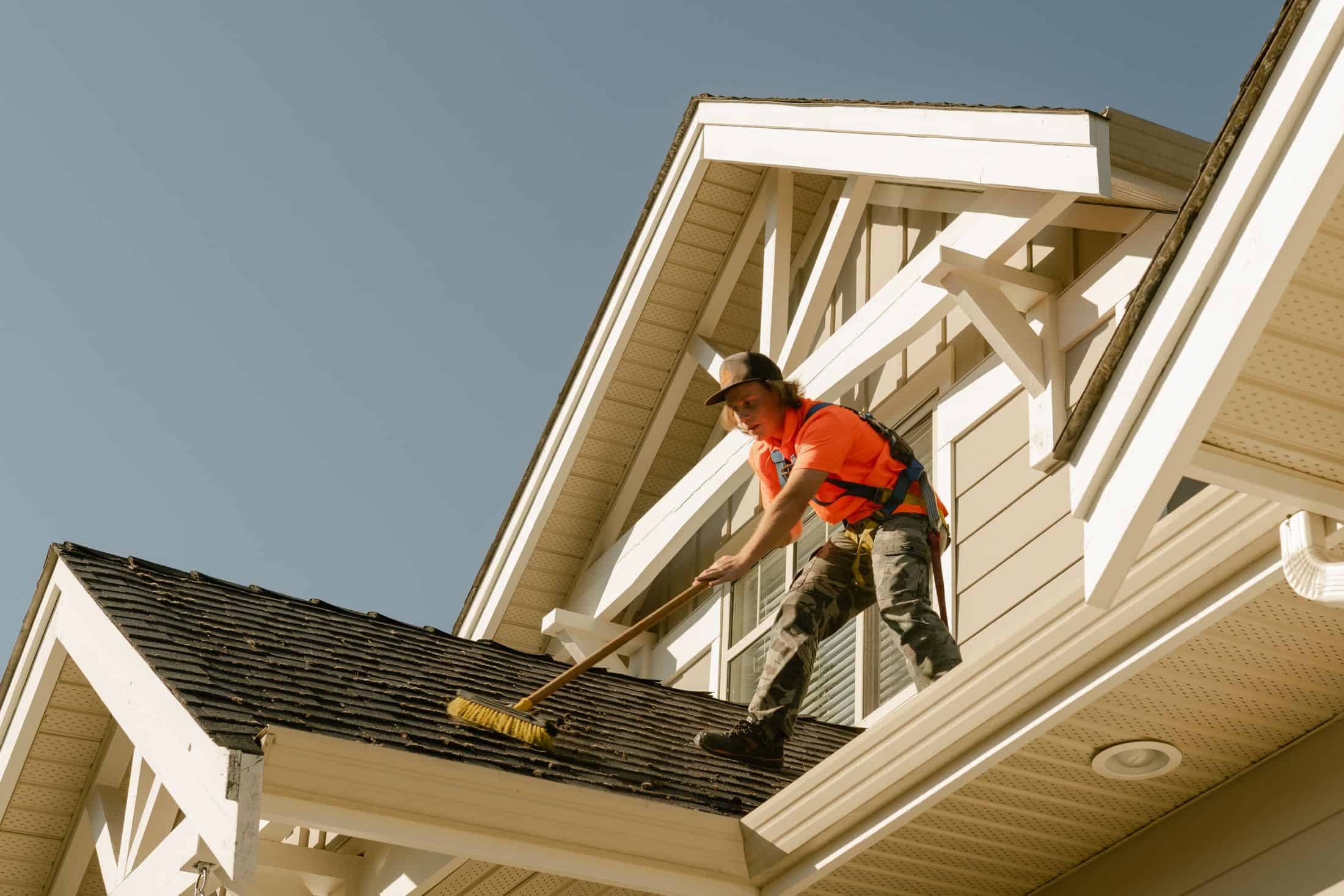
A soft-bristle brush takes the bulky top growth off. No wire brushes, no grinding at the shingles.
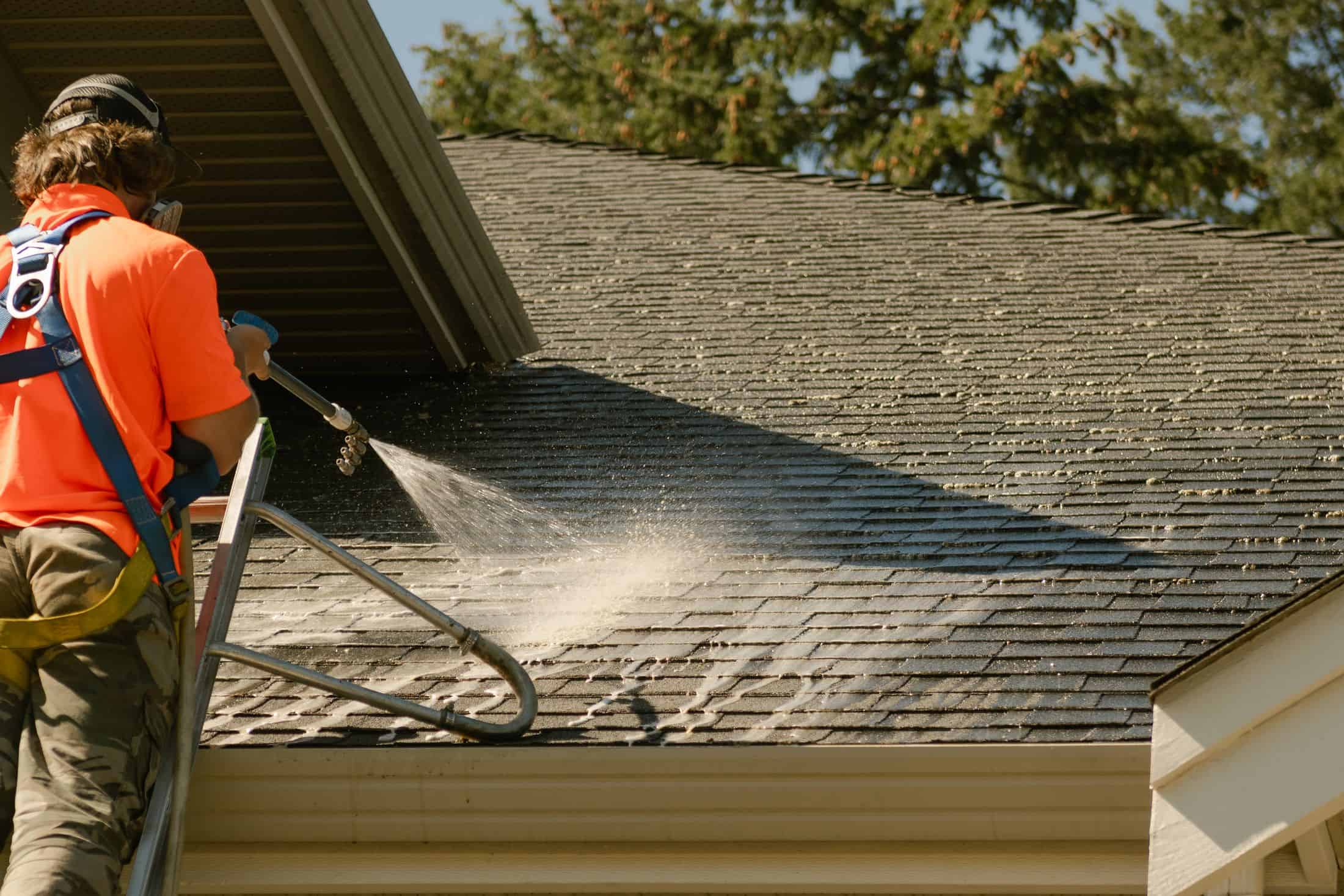
Treatment goes on at low pressure. The roof is never pressure washed.
Kelowna gets a third of Vancouver’s rain. So why is there moss on your roof?
Environment Canada’s climate normals put Kelowna at about 387 mm of precipitation a year. Vancouver gets about 1,189 mm. We live in a semi-arid valley, and yet moss shows up on roofs all over Kelowna, West Kelowna and Lake Country.
The answer is dew, not rain. Kelowna’s 6 a.m. relative humidity averages between 86 and 89 percent from September through November. Every fall morning, roofs wake up wet. On a south-facing slope the sun burns that moisture off by mid-morning. On a north-facing slope, or one shaded by a mature pine or a neighbour’s house, it lingers for hours.
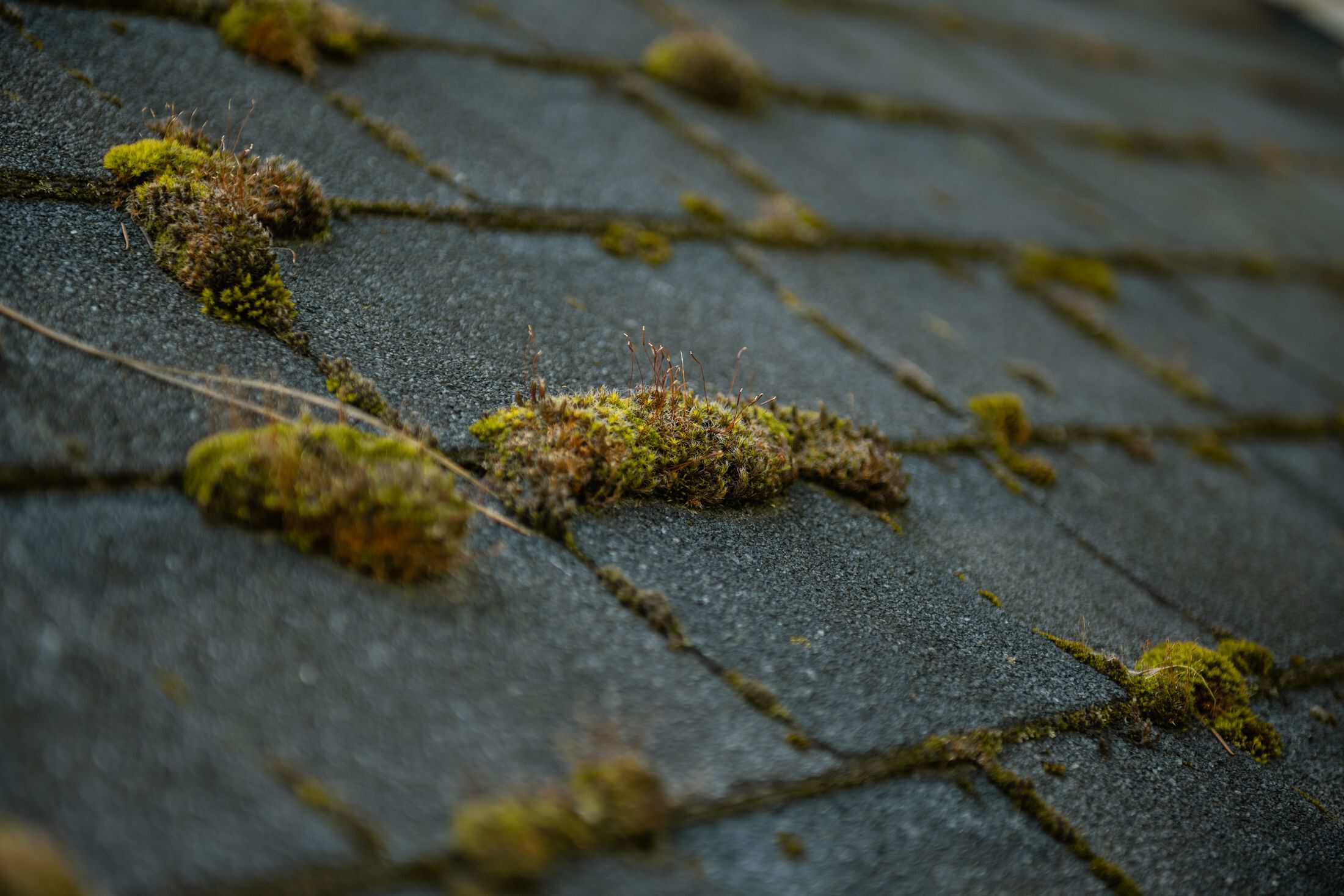
That’s exactly where the industry says to look. ARMA describes moss growing “on north facing roof planes that receive less direct sunlight and stay damp longer.” It’s why the same house can have a spotless south side and a green north side, and why the pine needles that pile up in shaded valleys make it worse: they hold even more moisture against the roof.
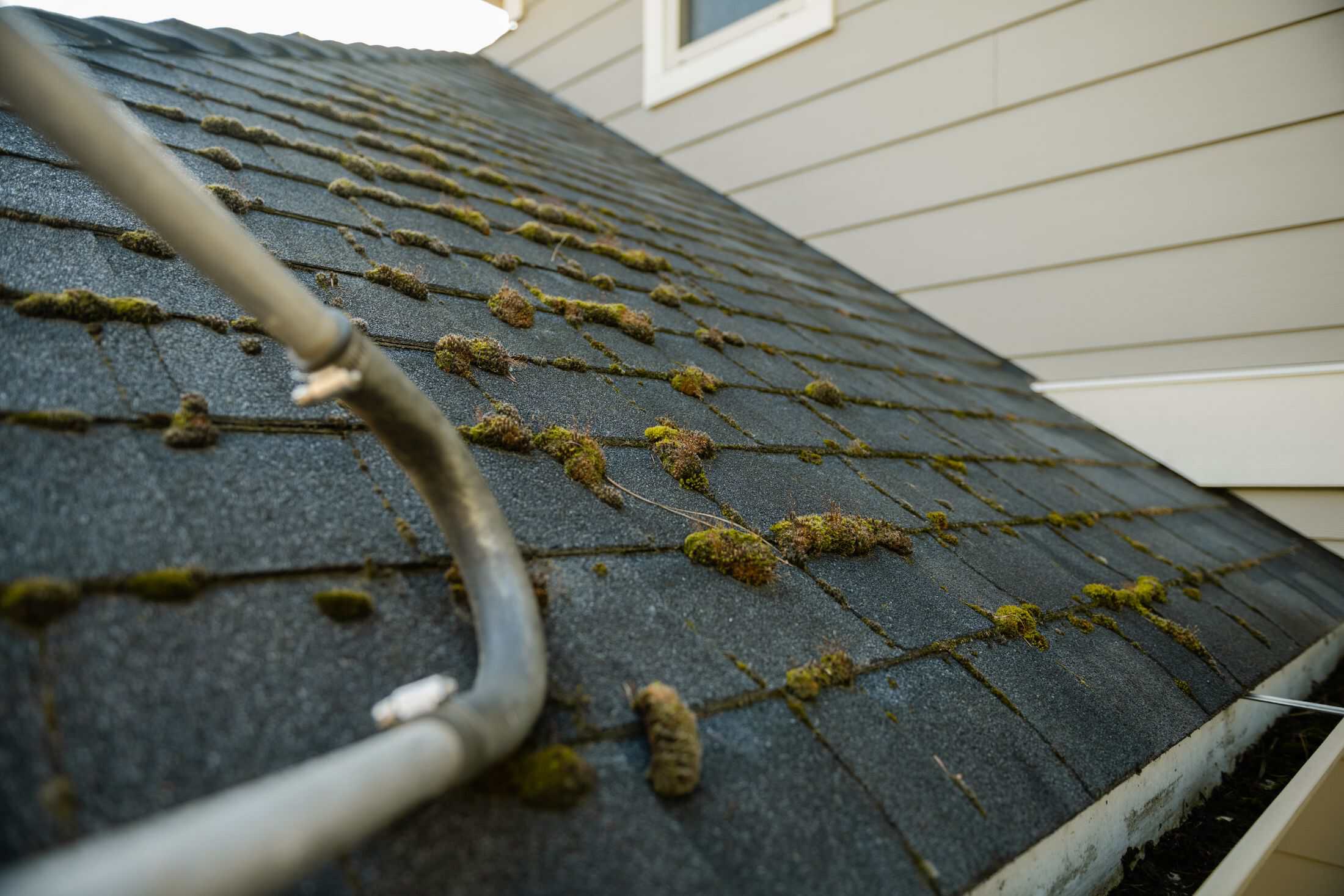
Moss collects along lower edges and valleys, right where water needs to reach the gutter.
What moss actually does to a roof (and what it doesn’t)
You’ll read online that moss “roots destroy shingles.” Botanically, moss doesn’t have true roots, and Oregon State University’s Extension Service says plainly that “the moss itself doesn’t directly damage roof materials. Instead, it traps soil and debris, holding moisture.”
That trapped moisture is the problem. Over time, thick moss can lift and curl the leading edges of shingles, which ARMA says “increases the risk of shingle blow-off.” It also slows or stops water running off the roof.
A 2022 BC Civil Resolution Tribunal case shows what that looks like in real life. A roofer found “heavy moss build up” in a strata’s roof valleys, “which prevented water from flowing into the gutters. So, water backed up” under the roofing and into a home. The tribunal accepted that the moss caused the leak.
So moss is a real problem. It’s just a slow one. Home inspectors’ InterNACHI training material calls moss “mostly a cosmetic issue” and its damage “a slow process.” That’s not a contradiction. It’s exactly why moss gets ignored until it becomes a leak, and why a rushed, aggressive clean-up feels justified when it isn’t.
What your shingle warranty covers (and what it doesn’t)
Most homeowners assume the warranty on their roof covers “the roof.” It covers something much narrower.
- It’s about manufacturing defects. CertainTeed’s warranty, for example, says that after the initial full-coverage period it covers “only manufacturing defects that caused water penetration.” A shingle that was made badly is covered. A shingle that was damaged is a different conversation.
- Moss isn’t covered. CertainTeed and BP Canada exclude moss by name. GAF, IKO and Owens Corning exclude lichen, fungus and other biological growth. No shingle warranty we found pays to deal with moss or the damage it causes. That part is on the owner.
- Some warranties exclude pressure washing damage outright. Owens Corning’s warranty excludes damage from “power washing.” Strip the granules with a pressure washer and you may have turned a covered roof into an uncovered one.
- “Lifetime” has conditions. Owens Corning’s lifetime coverage “applies only to single-family detached homes where the owner of the roof is the resident.” Condos and rentals often get shorter terms.
- The warranty that applies is the one in force when your roof went on. Terms change from year to year, so the installer’s paperwork matters more than today’s website.
Worth doing this weekend
- Find out what’s on your roof. The installer’s invoice, a leftover bundle in the garage, or the original warranty registration will name the brand and product line.
- Keep that paperwork with your house records. If you ever sell, buyers will often ask how old the roof is.
- Keep a simple record of moss treatments and gutter cleanings. It’s the easiest way to show the roof was looked after.
Zinc strips won’t fix the moss you already have
Zinc and copper strips along the ridge are often sold as the permanent answer. The evidence is thin. ARMA says adding them to an existing roof “is not recommended,” because they need exposed nails or breaking the shingles’ sealant bond. IKO says they “take time” and won’t handle an existing problem on their own. Oregon State’s 2026 guidance says the strips are “not effective to eliminate moss.” They’re a reasonable idea when a new roof goes on. On an existing roof, they’re a leak risk that doesn’t solve the problem.
Where the experts disagree
It would be convenient to pretend there’s one right way to do this. There isn’t, and you deserve to know where the arguments are.
Do you need to remove dead moss, or let it go? ARMA says moss “will loosen over time and may be removed with a leaf blower.” IKO says “dead moss must still be removed by hand.” Oregon State says to remove the dead material too. Everyone agrees removal should be gentle. They disagree on how much of it can wait for the weather.
Brush or no brush? IKO prefers lifting moss off gently by hand. CASMA allows a soft-bristled brush. Oregon State suggests sweeping moss off with a broom, gently, because “asphalt shingles damage easily.” Shingle maker Malarkey says roofers “often use a broom or leaf blower.” The common thread is gentle tools and a light hand. None of them recommends a wire brush.
How worried should you be? Manufacturers’ consumer pages lean alarming. Home inspectors lean relaxed. The honest middle is that moss is a slow problem that’s cheap to deal with early, expensive to deal with late, and easy to make worse with the wrong tools.
Before anyone cleans your roof, ask these questions
Use these with any roof cleaner, including us. Good contractors answer them without hesitating.
Will you pressure wash the roof?
The only right answer is no.
How will you get the moss off without damaging the shingles?
Listen for soft brushes and low pressure. Wire brushes, scrapers and pressure washers are the warning signs.
What happens to the dead moss, and what should I expect afterwards?
You want a clear answer on what comes off on the day and how the roof will look over the following months.
Will you clean the gutters at the same time?
Moss that comes off the roof goes somewhere. Usually the gutters.
Are you insured and WorkSafeBC registered?
WorkSafeBC requires fall protection from 3 metres up. Ask how the crew is tied off.
How we handle it at Live Next Level
We’ve been treating roof moss in the Okanagan since 2017, and our process is built around the guidance above. We never pressure wash. Our crews work on safety lines and use soft-bristle brushes to take off the bulky top growth (never wire brushes, never grinding at the shingles), then clean the gutters so the debris has somewhere to go, and apply the treatment at low pressure.
We’ll also tell you what to expect, because moss doesn’t vanish the same afternoon. After treatment it shrinks, goes dark, decomposes and weathers down. Most roofs look noticeably better in 4 to 12 weeks, and close to their best in 6 to 9 months.
Our Complete Roof Treatment includes a five-year limited warranty, and you’ll find typical price ranges on our pricing page.
The short version
Moss is worth dealing with, but it’s not an emergency. Take it off gently, treat what’s left, keep the gutters clear, and never let anyone pressure wash or wire-brush your roof.
If you’d like a second opinion on what’s growing on yours, request a free roof moss quote or call us at 778-767-4555. Most roofs can be priced over the phone.
Sources
- GAF, Technical Bulletin TAB-R-102 and Roof Moss Removal
- Asphalt Roofing Manufacturers Association (ARMA), Algae & Moss Prevention and Cleaning
- Canadian Asphalt Shingle Manufacturers’ Association (CASMA), Bulletin No. 13
- IKO, How to Remove Moss from Shingles and Canada Limited Warranty
- CertainTeed, Limited Warranty (2022)
- Owens Corning, Residential Roofing Limited Warranty brochure (2020)
- BP Canada, Shingle warranty brochure (2017)
- Malarkey Roofing Products, Managing Moss and Algae on the Modern Roof
- Oregon State University Extension, Moss (Solve Pest Problems) and How to control roof moss
- InterNACHI, Asphalt composition shingles
- Environment and Climate Change Canada, Kelowna climate normals (precipitation 1981 to 2010; humidity 1991 to 2020)
- BC Civil Resolution Tribunal, Edwards v. The Owners, Strata Plan LMS2600, 2022 BCCRT 723
- WorkSafeBC, OHS Regulation Part 11, Fall Protection